Peaceful relations with India are much more to Pakistan’s advantage than to India’s.
The
China-Pakistan Economic Corridor (CPEC) has the potential to be both an
opportunity and a threat to India’s security interests. Once the
project becomes operational, it may be feasible for Peoples Liberation
Army (PLA) armour and artillery to move within days into strike
positions on the India-Pakistan border. War between India and China
would damage the core interests of both sides for decades. Hence, it is
unlikely that President Xi Jinping would act any differently from his
predecessors during the 1965, 1971 and 1999 wars that Pakistan had with
India. During the 1965 conflict, the PLA did make a few threatening
noises over some goats and sheep that were claimed to have been stolen
by the Indian side. Several goats and sheep were thereupon marched by
herdsmen to the border with China, which was asked to accept them rather
than go to war for their sake. The livestock, which remained in India
while Chinese troops kept within their side of the frontier. In 1971 as
well, despite hopes in Rawalpindi and Washington that Beijing would
intervene in an effort to rescue the Pakistan army after it was attacked
by the Mukti Bahini-Indian Army alliance, the PLA did nothing. Indeed,
the US under the foulmouthed Richard Nixon did much, much more, even
sending a nuclear powered aircraft carrier to the Bay of Bengal in a
futile effort to overawe Indira Gandhi, who refused to halt her troops
until (what is now) Bangladesh was rid of a frankly genocidal Pakistan
army. In this, she differed from Jawaharlal Nehru, who agreed to
entreaties from Louis Mountbatten to cease fire on 1 January 1949,
before the entire state of Jammu & Kashmir had been liberated by
General Cariappa’s forces. Much later, during the 1999 Kargil episode as
well, the Chinese military did nothing. The reality is that the
leadership in Beijing sees the east Pacific coast as the probable
location for a future war, and is not eager to get involved in a
conflict with India on its west, no matter that this would be welcomed
by GHQ Rawalpindi. Also, the Chinese leadership is aware that there is
substantial potential for Sino-Indian commercial ties, and that this
would benefit the Chinese economy.
Now that the US has finally created
daylight between itself and Pakistan in the matter of strategic policy,
it should not take long for the military brass in Rawalpindi to
acknowledge that China is not going to come to their aid in the event
that the ISI’s meddling leads to a war between the two countries. Such a
conflict would hurt Pakistan far more than it would this country. An
accurate calculation of geopolitical interests indicates that peaceful
and cooperative relations with India are much more to Pakistan’s
advantage than to India’s. Peace between Delhi and Islamabad would
ensure that the Pakistan military be enabled to deal a knockout blow to
the many groups engaged in armed struggle against the Pakistan state and
its army. Such groups are continuing to operate in many locations
within Pakistan in large part because much of the army is deployed not
against them, but on the border with India. This despite the fact that
our country has for long been uninterested in another border war with
Pakistan. This could be the reason why some of the brass at GHQ
Rawalpindi are in favour of inviting India to join in developing the
China-Pakistan Economic Corridor (CPEC). The odds are that this idea is
also favoured by the Chinese side, and if so, the changed stand
indicates that the gargantuan lobby of commercial interests in that
country may slowly be pulling ahead of the PLA in the matter of
influence over India policy. Indeed, the PLA’s infatuation with Pakistan
serves the interests of GHQ Rawalpindi and not that of the Peoples
Republic of China (PRC).
Economic fundamentals favour close cooperation in the
commerce between India and China, the way the world’s newest superpower
has established substantial business and other linkages with the US, the
EU and even traditional foe Japan. This is despite the fact that at
least the first and third of this trio are strategic rivals of China in a
much more pronounced way than India is, and could in the future be at
war with China in East Asia or the South China Sea. While India may
provide logistical assistance to Washington and Tokyo in such a conflict
should there be formal obligations to do so as a consequence of the
expected strengthening of formal US-India military ties during the
Donald Trump presidency. This would be analogous to the way China has
assisted Pakistan on occasion without getting directly involved in
actual fighting on behalf of its ally.
Should the offer of elements of GHQ Rawalpindi to India to
join in the CPEC be genuine, it may be a good idea to accept it,
provided access along the CPEC is on terms similar to that provided to
any other country, including China. Goods from India should have land
access through the corridor, including into Afghanistan and Central
Asia. It is the reachout by India to Afghanistan that most riles GHQ
Rawalpindi. However, the reality facing Pakistan is that its economic
strength is not sufficient to once again effectively make much of
Afghanistan its colony. The first time around, in the 1990s, this was
accomplished through the backing of the US, a force multiplier that is
absent now. As for the Chinese, they are unlikely to want to invest too
heavily in a renewed Pakistani bid to regain its Taliban-era influence
over Afghanistan. Should such a reality get recognised by the generals
in Pakistan and access be offered to India through Pakistan into
Afghanistan and thereafter Central Asia, there would be merit in joining
the CPEC project without prejudice to any stand on legal borders.
Policymakers in India said “nyet” to Gwadar port, a permanent UN
Security Council, membership of ASEAN and several other offers that it
would have been advantageous to accept. Reason, and not emotion, should
dictate India’s response to a serious offer to participate in the CPEC.
WHEN politicians seek to portray themselves as saints, trouble is around
the corner. Given the manner in which politics is conducted across the
world, it is impossible to excel in that blood sport without cutting
several corners. In the case of the first female Chancellor of the
Federal Republic of Germany, this included her going against the
individual who had ensured her rise for over 15 years, Helmut Kohl. When
it became clear that Kohl was becoming unpopular, Frau Merkel began
distancing herself from him, finally leaving him in the ditch to get
elected as the leader of the Christian Democratic Union (CDU) at dawn of
the new century. Since then, she has shown herself to be ruthless in
dealing with potential rivals, as is clear from the fact that no fewer
than five politicians have each served as her Deputy since Frau Merkel
became Chancellor in 2005.
Each was removed not for not so much losing ground as in developing a
base independent of their boss while holding the position of her deputy,
thereby potentially becoming her successor. The result has been that
the second line in the CDU is so lacklustre and unattractive to the
electorate. The Chancellor wants only a single star within her party
(and indeed the country) and that is herself. Those close to Frau Merkel
say that she secretly covets the Nobel Peace Prize and has tried to
work out a strategy to get the honour. This would explain her otherwise
inexplicable move last year to absorb what will finally balloon before
2020 into three million refugees from North Africa and West Asia
entering into her somewhat insular country in case the Open Door policy
favoured by the German Chancellor continues into the next months. Of
course, the gesture ensured global headlines for Frau Merkel, including
TIME calling her the “Chancellor of the Free World”.
Clearly she has read TIME, for recently she gave a somewhat pompous
lecture to incoming US President Donald Trump about “democratic values”.
It will be noted that the policy favoured for migrants from
terror-stricken and terrorist-infested areas is the opposite of that
pushed by the German Chancellor. The terror attack on a Berlin Christmas
market by a young Tunisian migrant has begun a process of rethinking
within the German electorate that appears certain to ensure the defeat
of Angela Merkel and her party next year. In like fashion, the terror
attacks in Paris have given Marine Le Pen the best chance within the
contestants for becoming President of French Republic next year, despite
the commentaries awarding the prize prematurely to Francois Fillon,
victor over Nicholas Sarkozy in their party primaries.
The French seek change, just as US voters did, and Fillon does not
represent much change from the past, no matter how sharply he seeks to
delink himself from the past. More than Fillon, it is Le Pen who
resembles Donald Trump, with her sharply defined views on national and
international affairs. Although her rivals have sought to paint Marine
Le Pen as a political extremist and a bigot, such a characterisation
would be unfair. The reality is that the lady has substantially steered
the National Front party away from the extremely reactionary and racist
positions taken by her father Jean-Marie. Indeed, the daughter of the
National Front founder has been determined in ensuring that her father
and those subscribing to his extreme views no longer have a safe space
in party he dominated for decades, and voters in France have
sophistication needed to find this out for themselves.
To discover the difference between Jean-Marie Le Pen and Marine Le Pen,
hence the prospects for a victory by her in Round Two of the
Presidential polls is high, mainly because making it to the ultimate
round will convince many “soft” supporters of her that there is a high
chance of Marine Le Pen becoming Head of State of one of the most
internally civilised countries on the planet. In Round Two, such voters
are likely to come out of the closet and openly support her, way soft
Trump voters emerged once billionaire businessperson got nominated as
the Republican candidate for the Presidency of United States. Angela
Merkel is very similar to Hillary Clinton, in that both are highly
scripted politicians who clearly speak out of cue cards and who talk in
Politically Correct-speak.
In contrast, Donald Trump has never hidden the fact that he is confident
in being himself, despite being advised against this repeatedly
throughout the Presidential campaign, including by those close to him.
Finally, it was this courage to speak his mind , even about Russia, that
charmed millions of voters across the US to choose him over Hillary
Clinton, who ended up as the candidate of the two coats of her country
while being rejected by its heartland. However, unlike in France, where
the unpopularity of a sitting Head of Government will lead to the
election of a “Right Wing” successor, in Germany it is the Social
Democratic Party (SPD) that is likely to emerge the gainer out of a
Merkel collapse.
Indeed, the individual who was her predecessor, Gerhardt Schroeder, was
possibly the best Chancellor that his country ever had since Bismarck
more than a century ago. Schroeder forced through the changes in policy
that led to the success of the German economy after his term, a success
for which Frau Merkel took the credit. The present German Chancellor is
so determined to stamp out all or any influence of Gerhardt Schroeder
that she has inspired several negative press reports about him,
especially his friendships in Russia, a country also loathed by the
political foes of Trump.
So deep is her hatred for Schroeder that Chancellor Merkel has kept away
from top jobs in Berlin even outstanding individuals just because they
have been ( or still are) close to the former Chancellor. An example is
Michael Steiner, who was Foreign Policy Advisor to Chancellor Schroeder,
and who understands the world far better than most of his peers do, but
who has been sidelined by Chancellor Merkel as a consequence of her
Schroeder Phobia. Ironically, it will be the SPD that may be expected to
come to power in the coming polls in a victory made possible by the
unpopularity of a CDU led by Merkel.
Donald Trump clearly sees that it
is not Russia but China that poses the biggest threat to the US
supremacy, and that Beijing is the revisionist power.
The increasing probability of a war in East Asia involving the US, South
Korea and Japan against North Korea and China is growing. Within five
to six years, the Kim Jong Un regime’s arsenal of nuclear weapons and
delivery systems will reach the stage when severe damage is feasible
against the three allies, Seoul, Tokyo and Washington.
Thereafter,
secure in its home base, the Kim regime is likely to pursue a
destabilising policy of proliferating nuclear weapons and associated
delivery systems to Wahabbi states and groups that by then will be in a
state of low intensity conflict with major democratic states, including
India and the US. The only western leader who has understood the
centrality of the need to ensure that the Kim Jong Un regime be stopped —
through persuasion if possible and through force if not — is Donald
Trump. Given the rising likelihood of a war centering around the Korean
peninsula, the logic of a reachout to Moscow and Taipei is impeccable.
Were Taipei to take the side of Beijing in the conflict, the security of
Japan and South Korea would be severely compromised. And if Russia
could be prised away from backing China in a future East Asia war, that
would make victory for the Seoul-Tokyo-Washington alliance certain.
During the 1950s Korean war, it was Moscow’s assistance that enabled Mao
Zedong to hold US troops at bay, that and the policy of fighting with
both hands tied that was adopted by President Harry Truman in opposition
to the counsel of General Douglas MacArthur, who was removed from
command rather than allowed to unify Korea by force of arms through
fuller use of US military assets than had been permitted by the
haberdasher-President of the United States. Those looking beyond the
superficial will be able to discern a clear pattern in the foreign
policy thinking of Donald Trump: should an East Asia conflict be
inevitable, reaching out to Taipei and Moscow becomes essential, and
this is what is being attempted even before the 45th President of the
United States takes office on January 20, 2017.
While forecasting the
victory of Donald Trump in the US Presidential elections of November 8,
2016 it was obvious that the billionaire represented a welcome and
needed break from decades of Cold War-anchored foreign policy. Focussed
as this was on Moscow, such an Atlanticist focus suited both the
European as well as the US eastern coast elites, both of whom continued
to frame policy on the basis of a Euro-centred globe. Barack Obama saw
the absurdity in this, but lacked either the courage or the political
capital to seriously challenge an orthodoxy that had nourished both
Wahabbism as well as the authoritarian challenge to US global primacy
represented by the Second Superpower, China. Although Obama separated
some aspects of his administration's foreign policy during his second
term, towards the close, what was perceived to be the inevitable
succession of Hillary Rodham Clinton to the White House made the present
US administration revert back to the Euro-centred “Weltanschauung”
(World View) embraced by both the Bushes and the Clintons. With his
business acumen and ear to ground realities, it took Donald Trump to
challenge the Atlanticist orthodoxy in foreign policy, in the process
generating waves of hysterical commentary on the “dangers” of a Trump
Presidency. In actual fact, only the foreign policy now being enunciated
action after action, statement after statement (or tweet after tweet)
by President-elect of the United States Donald John Trump has the
potential to delink the US from the disasters that the Euro-centred Cold
Warrior foreign policy of the State Department and the eastern seaboard
policy elites have caused.
The collapse of the Union of Soviet
Socialist Republics in 1991 created an opportunity to integrate Moscow
into a collaborative world order. However, this would have meant the
ceding of paramountcy to Russia in Europe, an outcome that is anathema
to Atlanticists.
Encouraged by France and Germany, neither of whom
wished to integrate Russia into Europe, the Clinton administration made
use of mafias close to Boris Yeltsin in an effort at ensuring the
“pastoralisation” of Russia i.e. converting that country into a supplier
of agrarian and industrial raw materials, lacking an independent
technological base.
The attempt at the forcible conversion of a tech giant into a pygmy created a backlash against the Atlantic Alliance (including
NATO) within those policymaking groups within the Russian Federation
that were not under the control of individual or several NATO
member-states, and in Vladimir Putin, the country found a leader with
the brainpower and determination needed to ensure that Moscow emerge out
of its post-1991 chaos into the front rank of global powers, a task
that has been achieved despite opposition from NATO member-states led by
the US. Should Russia not be Enemy Number One, the very foundations of
the classic Euro-centred foreign policy will dissolve, hence the fury of
this establishment at the efforts of Donald Trump to effect a genuine
reset with post-Soviet Russia, a country that has the same Christian
majority as does the US, and which faces the same elevated threat of
Wahabbi extremism as do the US and India.
The 45th President of the
United States has anchored his policies not in the past but in the
future, when China may seize global primacy away from the US, especially
under the leadership of “Han Nationalist” Xi Jinping.
Through the
One Belt One Road (OBOR) initiative, Xi Jinping is seeking to convert
China into the backbone of global commerce, using infrastructure to link
Asia and Europe together, much the same way as the Roman Empire did two
millenia ago. The China-Pakistan Economic Corridor (CPEC) is less a
part of OBOR than it is a means to ensure that Chinese military assets
can reach into the heartland of India (Punjab and Rajasthan) in a
decisive manner and within days of the launching of a war against India
together with Pakistan. Given the neglect of indigenous weapons systems
by successive governments in the Lutyens Zone, in both aircraft as well
as in armour, China poses a military challenge to India that can only be
mitigated should the US move into India's corner in a far more decisive
way than was the case during the 1962 border hostilities between the
two neighbours. Unfortunately, the bureaucracy in India is as much Cold
War-oriented as is the case with the European counterparts they so
admire, and thus far, not even the logistics agreement with the US (LSA)
has been operationalised, much less than those dealing with
Communications Security (CISMOA) and with Basic Exchange (BECA). Whether
it be the heightened military threat posed by the CPEC or the need to
ensure that the Kim Jong Un regime does not reach the stage of
irremediable lethality in its nuclear preparations, or indeed the
broader conflict involving Wahabbi groups, close cooperation between the
US and India is essential for both sides, but despite this, both
bureaucracies are slowing down and attempting to sabotage such a
military alignment of the world's two biggest democracies.
Donald
Trump is not an amalgam of North America and Europe the way Hillary
Clinton or the (US) eastern foreign policy establishment is. The
businessperson turned leader is very much a child of his country and the
present. He sees clearly that it is not Russia but China that poses the
biggest threat to US primacy, and that it is Beijing rather than Moscow
that is overturning a global order that has maintained US primacy since
the close of the 1939-45 war. Aware that the US has only a narrow
window of five or six years before it will be too late to challenge
China effectively in theatres such as East Asia and the South China sea,
seeing for himself the imminent threat that North Korea poses to the US
and its allies in Asia, the newly elected President of the United
States is seeking to cobble together a geopolitical order that can
reverse the decades of decline that the Euro-centred, Russia-phobic,
China-boosting policies of the Clintons, the Bushes and the McCains have
created. Unlike his predecessor, whose courage falls far short of his
objectives, Donald Trump has been candid on the need to effect
foundational change in US foreign policy.
Small wonder that Euro-ized
elites such as House Speaker Paul Ryan are seeking to slow down or to
halt altogether the shift away from the toxic legacy of the past.
However, once sworn in as President of the United States, it is likely
that Trump will deploy his formidable communications skills to warn the
population that it is not Russia but China that represents the biggest
threat to continued US global primacy. Taiwan is crucial to success in a
future East Asia war, and Trump has therefore broken with the
Kissingerian doctrine of pandering to the Communist Party of China
through accepting its eventual supremacy over Taiwan. The incoming
President has publicly said that he no longer intends to follow an East
Asian diplomacy that is geared not to the core interests of Washington
but of Beijing. In such a context, the most important global partner
will be India, but the question is whether Lutyens Delhi will permit a
reconfiguration of defense policy so as to ensure a partnership with the
US that would checkmate the China-Pakistan alliance and its ongoing
program to create infrastructure that would permit the Peoples
Liberation Army to intervene in a Pakistan versus India conflict not
just across the Himalayas but prospectively into Punjab and Rajasthan as
well through the tank and artillery highway that is the CPEC Donald
Trump, with his focus on core US interests and on actual rather than
fancied conditions, can be expected to continue to work to ensure that
the accomodation given to Beijing since Nixon-Kissinger (and which
enabled a new superpower to emerge) get discontinued. His choices for
Secretary of State, Defense Secretary and National Security Advisor
reflect the next US President's awareness that war may be needed in the
Korean peninsula if Kim Jong Un is to be prevented from posing an
existential threat to the US, Japan and South Korea. The outreach to
Tsai Ing-wen ( who incidentally is a close friend of India) in Taiwan
reflects such hard-nosed calculation, as does his reaching out to
Vladimir Putin in an effort to ensure Moscow’s neutrality in a future
East Asia war. The role of India will be crucial in the emerging
security scenario. Donald Trump will move with more despatch against
Beijing the surer he is of a partnership with Delhi. Prime Minister Modi
needs to move beyond the Lutyens Zone in identifying strategies needed
to maximise benefit for India in the emerging geopolitics of a world
that will soon witness a Trump Presidency. What is needed is to ensure
that the economy of India move into double digit growth so that there
will be the means to ensure that the defense sector be adequately
provisioned. What is needed is to work out strategies designed to
prevent any erosion in security as a consequence of the CPEC. What
is needed is to position India as a reliable and effective partner in
the War on Terror as well as in ensuring the security of democracies
in Asia. President-elect Donald Trump has made his stand clear. In the
months ahead, especially on India, Russia and China. It is to be
expected that Prime Minister Narendra Modi will in the months ahead move
beyond the Cold War paradigm that the Lutyens Zone has for so long
espoused, including in an early start to direct conversations between
the leaders of the two biggest democracies in the world.
‘Out of 11 senior bureaucrats who were involved in the planning of the currency switch’, two are still ‘one hundred per cent loyal to the Lutyens Zone’.
India’s “Lutyens Zone” (analogous to the “Washington Beltway”) went into overdrive from 16 May 2014 to ensure that Narendra Modi becomes a single-term Prime Minister or even be forced to quit his office in between, as took place during 1979 in the case of the other PM from Gujarat, Morarji Desai. This strategy cannot be dismissed as impossible to implement. Although Rahul Gandhi has often been dismissed as an intellectual lightweight by several of his peers, according to a credible strategist working in the interests of the Lutyens Zone, the fact is that the vice-president of the All India Congress Committee “has been working to a plan to derail Modi from the start”. According to this source and another highly placed individual who has served as a core planner for the Lutyens Zone (LZ) leadership since the 1980s, the contra-Modi plan was “accelerated to take-off speed after he (Rahul) took effective charge of the Congress in November 2015”. The duo outlined the LZ “plan of action” since the shock collapse of the Congress in the 2014 polls. “We never expected the BJP to get a majority on its own, nor the Congress tally to go below 110”, the two significant sources said, adding that “it took about 19 months after 16 May 2014 before we were able to work out a plan capable of ensuring that the NDA would not return to power in 2019”. Both said that Rahul Gandhi “embraced the strategy fully, unlike those in his party who had been in leadership positions during the Manmohan decade”. These wanted to “continue with the past policy of cutting private deals with the BJP and putting on only a mock defiance of the new government”. From the start of mid-2015, when his grip over the rudder strengthened at the expense of the old guard of the AICC, Congress vice-president Rahul Gandhi “accepted our (dominant Lutyens Zone) view that with Narendra Modi in the Prime Minister’s chair, it had to be total war”, although sometimes cloaked in the language of conciliation. “Rahul understood that India would change fundamentally were Modi to win a second term or to have an unobstructed run in his present term”, the insider claimed, adding that “over the opposition of leadership elements in the Congress, Rahul insisted on a policy of complete opposition to the Modi government” so as to ensure that key measures such as the Land Bill or GST would not get passed early or preferably ever in the term of the Modi-led NDA.
According to them, “part of the strategy was to give misleading signals during Parliamentary sessions to those in the BJP who had been interlocutors with the Congress in the past”. These were informed that compromise was around the corner, when it was actually out of the question. As a consequence, the NDA government hardened its legislative position, especially on GST, in the expectation that “Congress would follow the UPA-period BJP strategy of opposing, but not obstructing” key legislative and other measures. The Lutyens Zone strategy was also to “create an international image at variance with the global picture of (PM) Modi as a reformer and as an individual who could get things done”. Simultaneously, contacts in media, civil society and governments in key countries were briefed extensively in a manner designed to give the impression of a government where minorities and the underprivileged were unsafe, and where crony capitalists were indulged. According to these sources, “the campaign has been successful, as can be seen from the proliferation of negative reports about the Modi government in the international media”. Whether because of a continuation of the “Vajpayee line” (of backroom compromise with the Congress while verbal pyrotechnics abounded in public), or “because (PM) Modi was advised by some key associates friendly to the Lutyens Zone that he should not appear vindictive, but statesmanlike”, the NDA government has thus far done almost nothing to enforce accountability on those UPA-era central heavyweights perceived as having made billions through stock exchange frauds, foreign currency manipulations and through tweaks in government policy. Additionally, senior bureaucrats who had acted as facilitators for senior UPA leaders during 2004-14, were allowed by the NDA government to continue in their posts and were often promoted to still more sensitive positions, as Prime Minister Modi sought to distance himself from any perception of bias or vindictiveness. Needless to say, such adherence to what may be termed a Prithviraj Chauhan strategy has not lessened the overt and covert campaign to hobble him in office and if possible to drive him out even before the 2019 polls.
According to the Lutyens duo, “out of 11 senior bureaucrats who were involved for 17 weeks prior to 8 November in the planning of the currency switch”, two are still “100% loyal to the Lutyens Zone” and therefore gave the government “advice that will boomerang on the government”. An example was the decision to replace the Rs 1,000 denomination note with a Rs 2,000 substitute. This “went against the logic of the metric system, where the deferred number mathematical theory points to 1, 2, 5 and 10”. It was pointed out by the strategists that throughout the globe, 1, 2, 5 and 10 (i.e. 10, 20, 50 and 100 or 100, 200, 500, 1000) are used to fix the value of currency. “By arbitrarily fixing 2000 and 100 as the two effective bands, the first has become useless in several transactions, while the latter is being hoarded”, a Lutyens Zone strategist pointed out, adding that the particular civil servant who recommended the Rs 2,000 note and withdrawal of the Rs 1,000 note “would get a Governorship when we take office by mid-2019 latest”. It was pointed out that the Rs 100, Rs 500 and Rs 2,000 bands are too far apart for ease of everyday transactions and would impact these even should currency supply normalise after ten months. The Lutyens strategist added that they “have been helped by the fact that a few officials are given wide discretionary power in the current administration, so much so that their recommendations are seldom re-examined before being implemented”. Another googly embedded in the policy, according to the sources, was the “hyper-high penalties for concealed income, which ensured that the grey market, rather than the exchequer got the benefit”. The source claimed that “our people in the system have consistently argued for high penalties so as to ensure the failure of disclosure schemes”. However, such claims of internal sabotage through toxic policies are impossible to verify, as the officials concerned would not implicate themselves by admitting to any role other than that of civil servants loyal to the government of the day. The two civil servants named as Lutyens moles by the strategists talked to are known for their efficiency and thus far, the absence of serious controversy.
The calculation of the anti-Modi brigade is that the manner in which the 8 November currency policy that was accepted by Prime Minister Modi after being strongly recommended by no less than 11 key officials and advisers, “will lower tax collections by stunting growth”. Consequently, “raids will rise and summary assessments multiply” as the government seeks to lower its deficit through squeezing taxpayers. This is expected to anger the middle class and the trading community, both of whom were significant parts of the Modi coalition in 2014. The expectation within the Lutyens Zone is that the present currency shortage will continue well past mid-2017 and result in lower growth for several quarters, perhaps even for years, thereby allowing the opposition to claim that Modi failed to generate growth and employment during his term in office.
They say that their supporters in the government have told them that there are several known bottlenecks in the process of printing of currency, “such as that there is only a single intaglio machine” at each printing centre, thereby slowing down considerably the output of fresh notes with even low grade security systems embedded in them. “All this was known (to the officials consulted in the matter), but not revealed to the Prime Minister”, these sources claimed, adding that “a highly-placed mole convinced the PMO that universalisation of digital modes of payment in a short time-span was possible, when in fact it is impossible”. He pointed out that e-wallets are less than 4% of GDP, and as for overall black money, “our estimate is that the total is around 18% of GDP” or around Rs 27 lakh crore. This includes cash, assets and foreign holdings routed through banks and hawala. Cash in Indian currency forms the smallest component. Hence the overall effect on black money of the 8 November measure would not be substantial. About the official who persuaded the government that cash equals black money and hence needed to be 85% drained out of the system in a single blow, “He will be given a constitutional position when we take office”, the source said with a smile. As for counterfeit currency, even when added to terror funding, the total comes to less than 1% of the currency value withdrawn on the midnight of 8 November 2016. Although it is impossible to verify whether Lutyens Zone moles were deliberately ensuring the sabotage through distortions in detail of Prime Minister Modi’s hugely consequential scheme, it seems clear that unpardonable errors have been made in both the conceptualisation as well as the operationalisation of the details of the swap of Rs 500 and Rs 1,000 notes for new Rs 500 and Rs 2,000 notes, as well as in calculating its after-effects.
As daily cash hauls testify, more than the wealthy it is the common man who has been hit hard by the 8 November move. Should daily consumption fall by 30% (the present situation, according to field reports), GDP will fall by even more than the 2% calculated by former Prime Minister Manmohan Singh, who must be a happy man these days, in that errors made during his years in office have now been forgotten in the flood of reactions to the 8 November extinguishing of 86% of India’s currency. As for the unorganised sector, which accounts for more than 90% of the total of jobs in India, that has been severely affected by a brilliant decision implemented in a less than satisfactory manner, although it is impossible to verify the claims made by Lutyens Zone strategists that several of the errors were deliberate and aimed at sabotaging Modi’s bold plans. Rules and restrictions have been changed nearly 40 times, while tax rates and penalties have been altered at jet speed. Overall, the impact of 8 November on trust and credibility in the banking system as a reliable store of value, and in the Reserve Bank of India as its guarantor, seems to be long-lasting.
If there is even a 15% chance that the two Lutyens Zone strategists are speaking the truth about moles in the present dispensation, the necessity is for a comprehensive investigation into who and how key decisions on operationalising the Prime Minister’s move were made that have subsequently turned out to be problematic. Those responsible for making recommendations that have subsequently become toxic, need to be checked out. More than any outside force, it is those on the inside who have the highest potential for inflicting damage on the Modi administration, and this may nowhere be clearer than in the manner in which the 8 November decision approved by Prime Minister Narendra Damodardas Modi has been implemented thus far, although knowing his strong personality, Prime Minister Modi is likely to continue to stand by his entire team despite increasing political fallout from the manner in which his 8 November 2016 announcement has been tweaked and implemented.
Prime Minister Modi will need to nudge his bureaucracy so as to ensure that they do not slow down or even sabotage his efforts.
Although
given to expansive talk about the global reach of India, much of the
bureaucracy within the country has yet to move sufficiently beyond its
subcontinental focus. Prime Minister Narendra Modi made the subcontinent
a high priority, breaking precedent by inviting SAARC heads of
government to his 26 May 2014 swearing-in and appointing a much admired
maestro of subcontinental operations as his National Security Advisor,
who thereupon chose other former colleagues with the same geopolitical
focus to man key slots within the security system. Overall, these former
IPS officers are of exceptional quality and have done excellent work,
especially in matters related to troublesome neighbours of this country.
However, Pakistan’s effect on this country’s security is not based on
its own domestic strengths as it is with Islamabad’s linkages. Hence,
the need to work on policy approaches towards both these superpowers as
would prise them loose from the hold that GHQ Rawalpindi has had on both
of them for several decades. For that, the still-powerful Lutyens Zone
element in the bureaucracy needs to go much further and much faster in
operationalising the Prime Minister’s innovative approach to both
superpowers. Unlike many of his predecessors, Modi has been unafraid of
both a closer security relationship with the US as well as a deepening
of the commercial relationship with China. However, on both fronts,
foot-dragging by a bureaucracy still anchored to the past has resulted
in the progress made on either front being well below the exploitable
potential. Not to mention the continuing obsession with Pakistan to the
neglect of several other parts of the globe that are far more
consequential for India.
In China, the Communist Party (CCP) ruling that country
since 1949 has for decades had a single-minded focus on the economy that
has resulted in hugely beneficial policies, especially after Deng
Xiaoping took over the leadership of the party. While Mao unified a
long-fragmented China, it was Deng who made certain that his country
broke away from the low-income trap that it had fallen into for
centuries. However, trade between India and China is still well within
the double digit range, despite its full potential approaching $300
billion. This would include investment by Chinese entities in India,
financial flows from PRC banks to entities in India, receipts from
tourism and services, as well as trade in commodities. Once annual
financial flows between Beijing and Delhi cross $150 billion, the hold
of the Pakistan-favouring People’s Liberation Army (PLA) on policy
towards India will begin to get diluted, and by the time such flows near
$300 billion, the CCP will embrace what has been a reality since the
1990s, that it is India rather than Pakistan that is beneficial to
China’s interests, and indeed that Islamabad has been for some time
antithetical to Beijing’s overall interests. Despite the rhetoric of
those who seek to ensure an adversarial relationship between Delhi and
Beijing and in the process throw away the China Card (thus placing India
substantially at the mercy of the US), Prime Minister Modi has sought
to change the paradigm for Chinese investment and tourism into India, a
process which needs to be liberated from the slowness with which the
security and financial policy establishment in India has dealt with the
matter thus far. Simultaneously, the Modi government needs to free
itself of the Lutyens Zone fear of Chinese reaction and forge closer
technological ties with Taiwan, especially in the field of cyber
security, apart from attracting investment from an island that has, thus
far, poured nearly $400 billion into the PRC.
As for the US, it is a measure of the lack of desire for
change of elements of the bureaucracy that even the logistics supply
agreement (LEMOA) with the US has not yet been operationalised. This
needs to be done within weeks, as do the signing and implementation of
two other “foundation” agreements, the BECA and CISMOA variants that are
being worked out between the US and India. Donald Trump has declined to
go the way of the Euro-centred strategic establishment of the US and
continue to point at Moscow as the main challenge to Washington, when
that position belongs to Beijing. Instead, he has—to hysteria from both
sides of the Atlantic—emulated Franklin D, Roosevelt by joining hands
with Russia, thereby seeking to wean that major power away from
overdependence on the actual threat to US global primacy, China. Unlike
the obsolete Moscow fixation of wannabe Europeans in the US, Trump has
made his choices on the basis of US interests alone, in the process
working on wooing another capital crucial to a future conflict with
China, Taipei, the shift of which to China would place the security
interests of Japan, the Philippines and Vietnam in much greater jeopardy
than presently. Given the China focus of Donald Trump, who has swatted
away the efforts of the Europe lobby within Washington to blackmail him
into falling in line and concentrating on Russia, it is clear that India
will be able to negotiate a productive bargain with his administration
in the matter of security, a circumstance which would make a more equal
commercial interface much easier to secure. However, for this to happen,
Prime Minister Modi will need to nudge his bureaucracy so as to ensure
that they do not slow down or even sabotage his efforts, the way it is
clear the Atlanticist cohort within Washington is gearing up to do come
20 January 2017. Whether it be in foreign or security policy, or indeed
in recent experiments with monetary habits, the need is for the Prime
Minister to be as firm on the bureaucracy, as the latter have been harsh
against the people of India. Unless this be done, achievement in India
will continue to lag far behind potential.
AROUND half of the previous century and throughout the preceding few,
European states had been in control of much of Asia, losing the
continent at least in a formal way only after two debilitating conflicts
in the 20th century. Subsequently, especially since the 1970s,
technologies were developed that democratised the ability to get
information and reduced its costs. Of course, mega corporations based in
the developed countries seek to charge extortionate prices for their
hardware and software offerings, often using law courts in their own
countries to get verdicts against competitors from Asia and to block
consumers from accessing low cost options to the wares of such
corporations.
Despite this, and in large part because of the altrusim of several
citizens in European and North American countries who have developed
free software, and a few manufacturers in the developing world who are
seeking to produce computer hardware are prices affordable to hundreds
of millions more global citizens than is the case at present, individual
citizens have been empowered by technology in a manner such as to
challenge the efforts of governments everywhere to have a monopoly of
control and influence over the citizen. Unfortunately, overall,
governments in the former colonial powers still hold on to the desire
for control, and this has found expression even in the present century,
which has been replete with UN-approved “trusteeships” being granted to
former colonial powers over their previous colonies, as for example the
UK ( together with the US) over Afghanistan, or France in Syria and
Italy in Libya.
Most of the sensitive components of the United Nations Organization are
headed by citizens of former colonial powers, and very soon, so will the
position of Secretary-General of the organization Nowhere has the
conflict of interest between the specific geopolitical imperatives of a
particular bloc of states and the general good of the entire
international community been so much in conflict as in the ongoing
conflict in Syria. Of course, CNN, BBC and television channels toeing
their line misrepresent the “international community” as referring
solely to the two sides of the North Atlantic, leaving out China, India
and Russia as well as most of South America and Africa from their
calculus. In colonial times, the populations of many of these countries
were inconsequential, and they have been calculated as so by media
channels still following the logic of the colonial era, where some human
beings counted for much more than others.
Conspiracy theories are usually overblown, and to claim that there is a
deliberate strategy by the Atlantic Alliance behind the ongoing collapse
of societies in the Middle East would be to indulge in fiction.
However, even if the reasons for the same are benign, the effect of
intervention by the US, the UK, France and other “western” powers in the
region has proved a disaster. From the final stages of the 19th
century, France and especially the UK backed the most extreme religious
zealots in the Middle East, or those whose ascendance would doom local
populations to a condition of educational stagnation and societal
degradation. Human rights were downgraded and democracy shunned. It had
been hoped that the new century would be different and that Tom
Friedman’s “Flat World” hypothesis would come about, but events have
made clear that the “flat” globe still has several mounds of unequal
opportunity disfiguring it.
In 2003, President George W Bush in effect made Iraq a colony of the US
and other military allies of his, ruling through Paul Bremer, a
proconsul whose knowledge of local conditions was as low as the level of
his administrative competence. Bush threw away victory in Afghanistan
by giving cash and weapons to radical warlords rather than to
modernizers. And after the 2011 uprisings in several Arab countries,
Hillary Clinton, Nicholas Sarkozy (then Francois Hollande) and David
Cameron armed, trained and funded fighters, many of whom joined Daesh
within months of getting largesse from these self-deluded individuals
Although Hillary Clinton has not for a long time been a formal part of
the Obama administration, her people are pervasive within it, and as a
consequence, much of US policy in the Middle East has been toxic to the
interests even of Washington.
However, few examples of self-defeating tactics would be able to compete
with the hysterical cry throughout both sides of the Atlantic Ocean to
save IS fighters trapped in Aleppo. Acting through Stefan de Mistura,
who is loyal not to the Secretary-General of the UN but to the
Secretary-General of NATO, there have been a flood of calls for a cease
fire that would permit the roughly 2800 hardcore IS fighters in Aleppo
to escape so as to form nucleii that would train more legions of
extremists in order to wreak havoc. Several of such hardcore fighters
would, if de Mistura had his way, be enabled to flee into Europe in the
guise of “moderate freedom fighters”, and once there set up terror cells
designed to create mayhem on the lines seen in France or Belgium.
Fortunately for the region, it is Donald Trump and not Hillary Clinton
who was elected on November 8, and although several in Team Trump nurse
the same skewed picture of Mideast reality as the Clintons do (no doubt
uninfluenced by hefty donations to their foundation from regional powers
pushing for the same strategy), the fact is that President Trump is
unlikely to defer to any views other than his own, and he has shown over
months of campaigning a refreshingly accurate understanding of ground
realities in the Mideast, targetting IS as the principal foe the way
Franklin Roosevelt focussed on the Nazi Party has the primary enemy of
the US during wartime. Aleppo is likely to fall into the hands of the
Damascus regime, and several of the 2800 hardcore IS fighters are likely
to have a very rough time, of course with the consolation that
policymakers in the US, France, the UK and other states that such
extremists will soon be concentrating on worked very hard to save them.
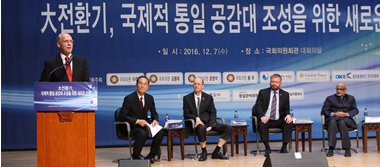
"New Approach to a Critical Turning Point: Buliding a Global Consensus for 1 Korea"
December 7, 2016, National Assembly Hall, Seoul, Korea Professor Madhav Das Nalapat, UNESCO Peace Chair, Department of Geopolitics and International Relations, Manipal University, India
THE ALLIES HAVE JUST FOUR YEARS TO AVOID A SECOND KOREAN WAR
The
1950-53 Korean War ended in a stalemate because the United States
followed the same strategy of what may be termed "truncated objectives"
that was in play during the 1990-91 campaign by mainly U.S. forces
against the Iraqi armed forces led by Saddam Hussein. That campaign
deliberately stopped short of occupying the country and removing the
Baghdad-based dictator from power, exactly as the Korean War ended with
Kim Il Sung still in power in Pyongyang.
Although the USSR
threatened to retaliate against any non-conventional (chiefly nuclear)
expansion of U.S. military operations in Korea, the reality is that such
a threat was almost certainly a bluff, as at that point in time, U.S.
nuclear weapon resources were far more advanced than in the Soviet
Union. However, it would not have been necessary to use the nuclear
option in order to ensure a decisive outcome to the 1950-53 war. The
capital of the People’s Republic of China, Beijing, was well within
missile distance of U.S. forces operating on land and sea in the Korean
theatre, and an intensification of the threat to its capital may have
ensured that the People’s Republic of China agree to cease fire on terms
much less favourable to the North Korean side than was eventually the
case.
President Eisenhower had clearly had enough of war, and
after personally witnessing the desolation caused by the 1939-45 war in
Europe, had not the will to expand the conflict in Korea to the
full-scope level demanded by General Douglas MacArthur. Truman, his
predecessor, had even less of an appetite for conflict, blocking KMT
forces in Taiwan from intervening in the situation caused by the
People’s Liberation Army getting involved in Korea, and blocking
MacArthur from doing any damage to military assets in the China side of
the PRC-Korea border, when such an assault would have sharply reduced
the firepower and offensive capabilities of Chinese and partner forces.
Finally,
unsure of whether the general would obey the restrictive orders placed
his way by President Truman, the 1939-45 war hero was replaced by
General Mathew Ridgeway, whose adherence to the restrictive instructions
of Truman as well as Eisenhower ensured not only two years of a
stalemate costly in human lives, but in a partition of the ancient
country of Korea that has continued to this date.
(right to left) Dr. Nalapat, Mr. Greg Scarlatoiu, Dr. Emanuel Pastreich, session moderator Dr. Jin Shin, and Mr. David Caprara
When
Mao Zedong took the offensive in the civil war with KMT forces during
1946, after a half decade of a policy of largely keeping his forces
intact while Chiang Kai-shek flung his troops into battle against the
occupying Japanese, the Chinese Communist Party (CCP) leader did not
stop until his forces had taken control of tracts of land effectively
ungoverned by Beijing for extended periods of time such as Inner
Mongolia, Tibet and Xinjiang.
Plainly, Mao was not in favour of a
"truncated objectives" strategy. In hindsight, had Chiang been less
active in seeking to reverse territorial gains made by Tokyo and instead
adopted a policy of holding on to the residual territory left to his
forces, they may have been able to finally overcome the PLA and reclaim
China from rule by the Chinese Communist Party.
Another factor
behind the success of the PLA was the supply of U.S. weaponry that
flowed to them in order to militarily confront the Japanese, despite the
reality that much of this was being stored for future use against
Chiang. It is to the credit of Mao Zedong that he sensed the direction
of the future wind, understanding that it was only a question of time
before the superior technology and resources of the United States
prevailed over the much less impressive forces under the command of
Prime Minister Hideki Tojo, just as towards the close of the 1960s, as
he surveyed the months-long clash with Soviet forces at the Ussuri river
in 1969, Mao understood the need for a modus vivendi with Washington if
he were to secure his country from trouble fomented by a far more
potent military force than he had, the armies and arsenals of the USSR.
Less
than two years later, the thaw with Washington came about, in large
part because in President Richard M Nixon the Chinese leader found a
practitioner of realpolitiik as clear about the evolving situation and
its needs as he himself was. As for the USSR, the entente between
Beijing and Washington so damaged its confidence that the immense
military arsenal the Communist Party of the Soviet Union (CPSU) had
built up over the decades since 1945 were made subject to the same
limitations that Truman and Eisenhower had imposed on their generals,
that of stopping short of carrying the battle into the territory of the
country that was sustaining the fighting capacity of the power in
combat, Kim il Sung's Korea in the case of the 1950-53 war and
Zia-ul-Haq's Pakistan in the case of the war that ended in the
humiliation and defeat of the Soviet armies in Afghanistan.
Had
Moscow carried the attack to Pakistan, for example by targeting
mujahedeen launch pads in Peshawar and Quetta, and warning of possible
attacks on Lahore and Karachi, assistance to the mujahedeen from within
Pakistan territory would have almost certainly been reduced to a level
capable of being overwhelmed by Soviet and secular Afghan forces.
The
geopolitical pain caused to the ancient Korean people by the division
of their country into two antithetical parts is in large part the
consequence of the early 1950s hesitations of two U.S. Presidents,
Truman and Eisenhower, who refused to deploy sufficiently the military
assets available to them to ensure that the peninsula remained united.
Such an outcome suited two neighbours of Korea. Both China and Japan
gained from the division of Korea, the first by ensuring that an ally -
in effect a satellite state - formed a vital flank on its external
boundaries rather than a power linked in a military alliance that was
also in strategic control of a former and potentially future adversary,
Japan.
Given the closeness of the Yalu River to Beijing and to the
Chinese heartland, it is obvious that the Chinese Communist Party would
not wish to see any power not under its sway in control of the
territory now in thrall to the regime in Pyongyang.
For almost a
decade which began towards the close of the 1990s, it seemed as though
the Republic of Korea (RoK) was leaving the magnetic pull of Washington
and moving into the geopolitical orbit of Beijing, the way Islamabad was
and still is. However, in recent years, the dissonance between CCP
support for the Kim family in the Democratic People’s Republic of Korea
(DPRK) and the core interests of the RoK have become more palpable, with
the consequence that there has been a return by Seoul to the strategic
ambience of the United States.
As for Japan, although the division
of Korea and resultant Pyongyang-Seoul tensions enabled Tokyo to
outpace the south of the Korean peninsula in economic terms for close to
three decades, finally the determination of the ancient Korean people
ensured that the RoK began to level with Japan in economic prowess
towards the close of the 1980s despite the vivisection of the peninsula,
in like manner as the Republic of India has emerged as a fast-growing
major economy despite the shock of its 1947 division through the
creation of the first country in the world formed exclusively on the
basis of religious belief, Pakistan, that from the first weeks of its
formation has expended its strategic assets on seeking to slow down and
finally reverse India's forward movement towards economic success.
If
Truman and Eisenhower were to get pointed out as the causes behind the
vivisection of the Korean peninsula, the focus needs to be on Presidents
Clinton and Bush II for their policy of side-stepping the operational
consequences of the evolution of the Pyongyang regime into, first a
significant threat to the RoK and Japan and, subsequently, to parts of
the U.S. itself. Both Clinton and Bush had the military power at their
command to decapitate the Pyongyang regime through "micro surgery"
before it could operationalise a credible response against Seoul.
By
"micro surgery" is meant the destruction of mainly military assets
without much damage to civilian infrastructure. Their successor,
President Barack Obama, does not have that luxury. To be effective, an
attack on the Pyongyang regime has to be of such kinetic velocity that
it would not be possible in between for the DPRK to let loose
destruction on a significant scale on assets within the RoK.
While
during the Clinton-Bush years, given the limited force of the DPRK
offensive machine, such a velocity would not have needed to have
resulted in a large number of non-military casualties. However, since
then the arsenal of this family-run half of the Korean peninsula has
developed to a level and sophistication that would take much more effort
to neutralize in the short time period needed to ensure the absence of
retaliation sufficient to raise the costs of such an intervention to a
level that would take a considerable time to rectify.
The Nobel
Committee showed extraordinary prescience in giving the Peace Prize to
an individual who had barely settled into his job. While President Obama
deserves some commendation for his refusal to get involved in wars such
as in Syria that are favoured by regional allies seeking to replicate
Libya in that country, in the case of the DPRK the hesitation of the
Obama administration to move beyond the timid bounds set by Carter,
Reagan, Clinton and Bush in their chastisement of Pyongyang has ensured
that the Kim Jong Un regime has developed into a security threat that
could in brief years ensure immunity for itself through the possession
of retaliatory capacity far in excess of that needed to prevent an
attack on itself.
As was pointed out immediately following the
events of 2003 and 2011, the fate of the two dictators who had actually
given up their WMD stockpiles acted to convince the Kim regime to avoid
that slippery slope towards an undignified end. The very advent of a
Donald J Trump administration on the heels of that led by Barack Obama
has convinced several leaders that it would be folly to rely on the word
of a President or a Prime Minister, not only because he or she may soon
get replaced, but because he or she may change his or her mind, the way
Nicholas Sarkozy did about Muammar Gadhafi. Such a dynamic has made the
reaching of an amicable settlement with the Kim dynasty in Pyongyang
unlikely.
Working out an arrangement that would assure an amnesty
to Kim Jong Un and other regime heavyweights in exchange for peaceful
reunification would be the best case scenario, despite offending human
rights purists intent on "sending a message" to other serial depredators
of human rights by inflicting severe punishment on the Kim group in
Pyongyang. While such an outcome would be possible, the cost in human
terms would be considerable, thereby making it more advantageous to
"write off" the sufferings inflicted by the DPRK regime on its victims
while ensuring that these get capped as a consequence of the agreement
reached.
In the recently conducted Presidential elections in the
U.S., Donald Trump was from a foreign policy perspective a more hopeful
prospect than Hillary Clinton, his presumed "weakness" being in reality
his strength. The weakness of Donald Trump has been his lack of
familiarity with foreign policy doctrines and those who have fashioned
them. This sets him apart from Hillary Clinton, who visibly relies on
the autopilot mode in policy discussions, going by the wisdom of her
advisors on what would be the best course to take.
Trump, on the
contrary, flies manually. If we consider that the primary "control
towers" (aka policy formulators) within the Atlantic Alliance have often
guided their "aircraft" into squalls and occasional crashes (among the
more spectacular being interventions in the Middle East since 2011), a
"pilot" who refuses to follow such guidance is much more likely to land
his aircraft safely, i.e., ensure that a policy get formulated and
operationalised that ensures a favourable outcome for the country making
them.
Within the U.S., or indeed the British and the French,
policy zones, there is a constant return to the errors of the past.
Given that adopting a contrary line would amount to admission of error,
it seems almost reasonable why so many "experts" would lay out policy
menus for their political patrons that are in essentials
indistinguishable from options given in the past and which later proved
disastrous.
In the Korean theatre, a longstanding policy of
carrots that are too small to entice followed by sticks, the effects of
which on the Pyongyang elite are limited, has failed and yet gets
endlessly repeated. Given the reality of the Kim regime moving closer
to a stage in which it would have the capacity to deter any attack by
the credible threat of unacceptable damage, the four years of the Donald
Trump administration that begin January 20, 2017 represent perhaps the
last window available to resolve the Korea problem through a peaceful
unification of both parts of this vibrant territory. Once this is
achieved, avoiding the errors made during the German unification process
in the 1990s could be possible, including an artificial equalisation of
currency used in both sectors, thereby erasing the cost advantages of
investing in the poorer segment.
Given the essentiality of
unification, literature needs to be created that is designed to ensure a
smooth fit in modern Korea for those who for their entire lives have
survived in a time warp. It is difficult to visualize a glide path
towards unification, but this would be certainly be preceded by a
showcasing of force and resolve by the U.S., the RoK and other
militaries that convinces the leadership in the north that any conflict
would result in a defeat for the lesser armed force.
Next, it is
necessary to ensure that Beijing be on board in international efforts to
unify the peninsula, by for example guaranteeing the demilitarisation
of the territory north of the 38 parallel and by imposing financial and
other geopolitical costs should the PRC not participate in punitive
measures activated in a situation of "bad" behaviour by the DPRK.
No
such move will work unless Beijing signs on to it, and the only way to
ensure this would be to ensure that the cost of PRC non-participation in
international efforts to ensure "good" behaviour by Pyongyang be made
clear and significant by the U.S. and its allies, and of course get
enforced whenever needed rather than ignored as has too often been the
case in the past.
The key to the ushering in of unification is not
Seoul or Washington as much as it is Beijing. The perception in
Pyongyang that it enjoys immunity from retaliation for its armed
provocations needs to be countered by visible and disproportional action
against the Kim family regime in such instances. Any reaction to the
reaction needs to be met with a fresh volley of retaliation. Those
arguing that such moves will lead to a full-scope nuclear war are wrong,
if only for some time to come the Kim Jong Un regime will be unable to
mount a credible nuclear response. Once it is able to do so, the world
and East Asia in particular will be entering uncharted territory. Hence
the need for action during the window available before the activation of
nuclear weapons systems by the DPRK.
The regime in Pyongyang is
rational and does not have the suicide bomber gene in its intellectual
makeup. However, deterrence will be credible only if there is a unified
command facing the DPRK, in which the U.S., Japan and other
participating powers ensure that Seoul be given a place of honour, with
key slots in the unified command going to its officers and the overall
political guidance of the Unified Command being vested in the Blue
House.
If the stick be substantial, so must the carrot be of
generous proportions. This would include incentives for elements in the
Pyongyang regime to invest in the RoK so as to acquire a physical stake
in unification. Travel curbs should end, as those who are the most
hostile are precisely the individuals who need to test their perception
of reality with the ground situation in the "enemy other."
Financial
curbs on outward and inward investment between the two halves of Korea
should be liberalised, such that a network of "facts on the ground" gets
created with a centripetal effect. Limited sticks, small carrots and
quarantines have repeatedly failed and yet established foreign policy
elites keep returning to such nostrums for fear of testing out the
unknown.
The world has around four more years before the two
halves holding a noble people either get unified or a situation gets
created in which the international community will need to decapitate the
regime in Pyongyang for the survival of stability in Asia. Now that an
innovative business leader is taking over the reins of government of the
world's most productive country, it is time to (1) open doors to the
north, (2) set in place the means for deadly force should peace prove
unworkable, (3) use such means to inflict severe harm, with the
certainty of much more than any possible reaction can be, including the
pinpoint use of all possible means of force at the command of the allies
of the RoK and (4) indicate that time is running out for a regime that
needs to realize that the survival of its elements can only continue in a
situation where there is a mutually honourable settlement that is based
on the unity of the Korean people, and which would in its governance
structure include personnel from both sides till such time as such
distinctions become an irrelevance.
The world has four years to
prevent a war with possibly nuclear consequences that ought to have
ended in 1951, had President Truman trusted his military leadership to
finish a job that was only half complete when the 1953 armistice was
declared, and which has continued in that state to the present.
By M D Nalapat | Seoul She became aloof and disconnected from both the people and party rank and file.
Being in the capital of South Korea for a conference on
Korean Unification held in the National Assembly building was an
experience which showed how far this country, small in territory but
huge in economic success, has come in the maturity of its democracy.
More than two million citizens congregated around the National Assembly,
holding candles and singing songs, calling for President Park Geun-hye
to resign forthwith. Elected on 25 February 2013, Park is the eleventh
President of the Republic of Korea, and led her Saenuri Party to a
comfortable plurality in the National Assembly. However, a little over
three years later, the overwhelming majority of the population have had
enough of her, and have taken to the streets to nudge a reluctant
Parliament to remove her from office. Thus far, despite weeks of massive
agitations against Park, there has not been a single arrest by the many
police personnel placed around the National Assembly. The sympathies of
those in uniform were with the protestors. And within the crowds, there
was a festival atmosphere. Songs were sung, little children brought
along “to watch history being made”, and there is satisfaction that
Parliament—including the ruling party—will hold impeachment hearings.
Judging by the mood of the voters, most of whom had backed President
Park just three years ago, it seems clear that her days in office are
numbered. President Park’s fate is a cautionary tale for democratically
elected leaders everywhere of the speed with which public opinion can
change, and how pressure from large numbers of citizens could force
legislators to take action against an unpopular, albeit elected, leader.
What explains the collapse in the
political fortunes of the daughter of the dictator, who between 1963 and
1979 made South Korea a global powerhouse of enterprise? When President
Park Chung-hee’s wife died, it was only daughter Geun-hye who fulfilled
several of the roles of the First Lady. Perhaps the five years of
experience in the Blue House as the right hand of her autocratic father
gave the current President of South Korea a distorted picture of the
role of an elected leader.
After all, voters do not want to see
their elected leader morph into a monarch, ruling in a manner as
absolute as a dictator. In the case of President Park, there was
certainly the question of her ties to an intimate female friend and the
manner in which this individual used her sentimental hold over the
President to get monetary and other favours from big business interests.
However, this would not have gained the traction it did but for the
fact that Park Geun-hye began to behave much in the manner of her
father, who of course was a military dictator with zero popular mandate.
Those who know her say that she became aloof, so much so that she even
refused to have lunch with others while on tour, eating alone in her
room in the manner of a royal potentate. Park would fix appointments and
cancel them at the last minute, even while those who had come from long
distances to see her were kept waiting in the Blue House for hours.
The President apparently saw legislators
as lowlife, because she seldom found the time to meet them individually,
preferring to leave that task to subordinates. These were themselves
rude to both the public as well as to elected representatives, and
spurned any request with contempt. The consequence of such an attitude
is that several ruling party legislators joined with the Opposition to
ensure her impeachment.
Members of President Park’s party say
that soon after she took office nearly three years ago, the lady became
aloof and disconnected from both the people as well as the party rank
and file. She would meet only the seniormost leaders of the party, and
that too not for the purpose of getting their views, but to give orders
that she expected to be followed without question. Soon the ruling party
headquarters became a venue where the ordinary cadre was absent and
only those in big cars who were billionaires were welcomed. Geun-hye
Park lost all touch with the people of her country. She spent her time
mostly in the company of a few officials, who were too afraid to
challenge her and who nodded their heads at everything she said. Apart
from high officials, the only other regular visitors were big business
representatives. Several of them had been assisted early in their
careers by Park Geun-hye’s father, the late President Chung-hee Park,
and the new President treated them as her subordinates, ordering them to
appointment those she favoured and implement measures demanded by her
or her close friends. President Park even sought to silence dissent by
punitive measures against some individuals who disagreed with her. Laws
were tightened, especially concerning freedom of the internet, which
made South Korea a democracy where there were almost as many curbs on
the internet as in authoritarian states.
At the same time, those close to Park
were given privileged treatment, including admitting undeserving
children in universities and in companies. Such favouritism angered
young South Koreans and drove hundreds of thousands of them to the
streets of Seoul to demand the resignation of the President. Her own
team has been ineffective, largely because the President chose people
whom she liked rather than those who were competent in the tasks
assigned to them. She ensured a collection of favourites around her who
were incapable of functioning in a manner that gained the public trust.
The impending downfall of President Park has been caused by her
misinterpretation of the mandate of the people as a licence to rule as
she wished rather than the way people expected her to. She ought to have
chosen competent and honest people rather than vapid flatterers, and
should not have confined her contact to greedy individuals out to make
money through closeness to her. Park should have kept in daily touch
with the common people and with independent minds rather than only with
fawning officials and avaricious billionaires. The fate of Park Geun-hye
shows what happened when a democratically elected leader deluded
herself that she had been crowned an absolute monarch.
Prime Minister Nawaz Sharif of Pakistan is now aware how erroneous
multiple news reports were of Donald John Trump, who is on January
20,2017 to be sworn in as the 45th President of the United States. The
anti-Trump tone of leading US news channels made them fodder for the
Hillary Clinton campaign, who clearly had a dim view of their own
candidate. From John Podesta onwards, Clinton campaign staffers were
honest to each other about the shortcomings of their boss, which
explains why the focus was on denigrating Donald Trump. The message to
the US voter from the Clinton campaign was : Hillary may be awful but
Trump is worse, so choose the lesser evil. However, the media storm
against the Republican Party nominee for the Presidency resulted in a
swelling of the sympathy vote for Trump that was big enough to ensure a
comfortable victory on November 8. Among the other epithets hurled at
Trump was calling him unmannerly, indeed rude.
However, his conversation with Nawaz Sharif shows that President-elect
Trump is both polite as well as determined in his refusal to stick to
diplomatic niceties in conversation. Of course, the friendly tone cannot
hide the determination hidden underneath to ensure a better deal for
Washington in any transaction with the rest of the world. Donald Trump
has not been elected by the “international community” but by US voters,
and he will not forget this for an instant as he seamlessly moves ahead
to the 2020 Presidential campaign for a second term in office. Those who
write off Trump as being “inexperienced in government” forget that
business is the most unforgiving crucible of all, where not merely
goodwill but personal wealth is the forfeit for wrong decisions. The
permanent bureaucracy prefers those who have served long stints in
government, for they would have learnt how to ensure that their
“political masters” in effect become the servants of the bureaucracy,
doing what the services seek of them. They dislike Trump because he does
not have this experience, and therefore they are unfamiliar as to how
they can “manage” him.
That in a democracy it is the politician who should manage the
bureaucrat and not the other way about never enters their heads. For the
civil service, elections are a mere distraction, to be given lip
service but not to be taken seriously Donald Trump believes in the power
of his personality and therefore in personal diplomacy. He is also a
very confident person, for otherwise he would not have spent nearly $
100 million of his own money ( or more personal cash than all previous
US Presidents have spent on their campaigns). An example of this
confidence was his accepting a request by Taiwan’s elected leader Tsai
Ing-wen to have a phone conversation, the first between a US President
and the head of a Taiwan government for four decades. From that time,
all IS Presidents and President-elects have accepted the guidance of
their bureaucracies to avoid any direct contact with Taipei. Donald
Trump is outside that mould, and it would not be a surprise if he
becomes the first US President to visit Taiwan since Dwight David
Eisenhower.
By throwing away Henry Kissinger’s diplomacy book, Donald Trump has done
diplomacy a favour and indeed, once again making the art relevant to
the lives of the people rather than merely serve as a source for
newspaper headlines. The US Department of State is known for its
maestros in the science of planting misleading news and commentary items
in the media, and officials within have gone into overdrive seeking to
condemn President-eect Trump for his effrontery in not going by their
advice in all matters but following his own conscience as well as the US
Constitution, which enshrines liberty and equality as fundamental
rights.
State Department officials usually morph into apologists for the
countries they deal with, often exchanging their bureaucratic career for
representational and lobbying posts for these very countries. An
example is Robert Blackwill, who made about a million dollars from the
poverty-stricken Republic of India after having served as the US envoy
to Delhi and done all that he could to darken the investment climate by
portraying India during the Vajpayee years as a step away from nuclear
war. Of course, several US policymakers and “South Asia experts” later
claimed credit as well as secured funding for averting a nuclear war
that existed only in their imaginations.
Hence it is no surprise that officials dealing with East Asia are
horrified at the actions of Donald Trump, venting their fears in the
“planted news” publications of choice for the US State Department, the
New York Times and the Washington Post, besides CNN. They underestimate
the maturity and calm of the Chinese leadership led by Chinese Communist
Party General Secretary Xi Jinping. As the US and China are so integral
to each other’s economies, it is unlikely that Beijing will respond in
an angry fashion to the President-elect’s telephone conversation to the
President of Taiwan. The Chinese play a long game and are willing to
accept a few reverses along the way, provided the overall direction is
where they want to go. Most importantly, Trump has an ally in an
individual greatly respected in Beijing, Vladimir Putin.
The President of Russia can be expected to ensure that China’s reaction
be such as will not further roil the already turbulent waters of
US-China relations. Because President Obama has relied so completely on
Clinton administration retreads in his team, much of US foreign policy
has in effect worked against US long term interests. As Obama demits
office, relations with China and Russia are bad, and that with few
countries barring Myanmar and Cuba better than when he took charge of
the administration nearly eight years ago. The situation in the Middle
East is dire after Hillary Clinton’s experiments in regime change
literally blew up in the faces of policymakers, while that in most other
parts of the globe is little better.
Obama has succeeded in a few fields, those where he was courageous
enough to adopt a view at sharp variance with that of the Clinton
cohort, such as with Cuba and Iran. Although several in Team Trump seek
to upend both agreements, the intensely practical 46th President of the
US is likely to ensure that both relationships remain in a healthy
condition, of course with some tweaks. As for the Trans-Pacific
Partnership, this is likely to be replaced by a new agreement that
ensures the centrality of the US in the trade flows of Asia. This
advantage is the “baby” that will not be thrown out of the bath water by
President Trump.
Donald Trump the candidate refused to run to a beat other than his own,
and this trait is likely to continue into the White House. While such an
unorthodox stance may result in some increase in the blood pressure of
senior officials in the US State Department (especially if the
Trump-phobic Mitt Romney becomes Secretary of State), overall US
interests will be advanced by a confident Head of State refusing to bow
before 19th century concepts masquerading as pragmatism. The telephone
calls made to and from Donald Trump indicate a mind fixed on outcomes
and willing to adopt unusual ways of reaching them.
It would be difficult to determine if exposure to the national anthem
before watching a movie actually increases the patriotism in the mind of
the citizen.
The
Supreme Court of India has decreed that the national anthem be played
in all cinema theatres and that cinegoers stand to attention during such
a recital, with all exits closed. The objective of the order is to
ensure that the spirit of patriotism rises within each cinegoer, a
desirable process that hopefully gets created when the anthem gets
played on screen. The significance of this order on the rights of the
citizen is immense. Hence many may regard it helpful for the court to
define precisely what “patriotism” means, apart of course from standing
to attention whenever the national anthem gets sung. What are the other
requisites of this noble and necessary quality in the citizen, and would
it not be best were the Supreme Court to order that the observance of
each of these conditions be made mandatory for the citizen? Perhaps the
country will soon get the benefit of a fuller order, in which each of
the essential components of patriotism gets listed and made compulsory
for citizens of India. Also, some may argue that patriotism needs to be
constantly refreshed in each individual, not only in a cinema theatre,
but also in other locations frequented by the public.
The national anthem is indeed a magnificent composition.
It is impossible not to feel a surge of emotion when listening to its
language. However, some believe that the anthem should not be used in a
medley of locations, but rather be played on occasions that are of
greater import than the screening of a film of less than stellar
quality. Also, that a decision on whether the occasion be solemn enough,
significant enough, to merit the privilege of having the anthem played
be left to the discretion of individual citizens, rather than to the
police or other agencies of the state. If a school or a college is
holding a function that is regarded as important, it may be fitting to
begin or end the proceedings by the playing of the national anthem. If a
factory has broken global records in quality, at the celebratory
function held on the occasion, it may be appropriate to play the anthem
so as to highlight that the citizens of India, who are almost without
exception reverential to the national anthem, are among the finest in
the world. However, we need to be reminded of the reality that the
difference between a democracy and an authoritarian system is the fact
that in the former, the overwhelming majority of decisions get taken by
private individuals and not by command of the state.
Incoming US President Donald J. Trump would be delighted
at the Supreme Court’s anthem verdict, although it is unlikely that the
Court in his own country would go along with their brothers in the Apex
Court in Delhi. Even Antonin Scalia, regarded as the most conservative
of judges, was clear that only a monarch could decree that the US flag
be kept inviolate. Scalia said that US citizens were immune from penalty
even if they were to publicly burn the flag, while of course,
soon-to-be President Trump would like such individuals to even be
deprived of their citizenship. India does not any more have a monarch on
a throne, in Delhi or in London, but an elected government. Seeking to
enhance patriotism through the anthem being shown in cinema theatres may
not always work, as it would be difficult to determine if exposure to
the national anthem before watching a movie actually increases the
patriotism in the mind of the citizen. In jurisprudence it is, after
all, the “mens rea” and not the “actus reus” that determines if a crime
has been committed, i.e., the thought must precede the act and not be
disengaged from the latter. What if a citizen has fulfilled the “actus
reus” of standing up in respect to the national anthem, but his mind,
his “mens rea”, is less than respectful? After all, the emotion, indeed
the instinct, of patriotism is a quality that needs to get rooted in the
mind, and as yet, thoughts are much more difficult to fathom than
actions. Not forgetting of course that the mind in the Knowledge Era
thrives in a culture of freedom.
Why do students in US universities do better in life than
those in many universities in India? Perhaps because students in India
are spoon-fed, force-fed in fact. They are drained of initiative and
individualism and are subjected to the constant hammer blow of enforced
conformity, while students in the US are encouraged to think and act for
themselves and indeed, to challenge what their professors seek to drill
into them. The Indian mind is at least as versatile as any other, if it
were not constantly constricted by a web of regulations that takes away
huge tranches of the freedoms available to citizens in all other major
democracies. Even without this latest fiat by the Supreme Court, an
institution that merits the admiration of every citizen, this columnist
has risen to his feet whenever the national anthem gets played. Not
because he has to, but because he wants to. And not every individual who
remains seated may be unpatriotic. Some of the sitting may, indeed,
have done greater service to this country than those standing up. Each
citizen has, or ought to have, the right to express his or her
patriotism in the manner he or she deems proper, without being made to
follow a particular menu of actions regarded as being the attributes of
patriotism. The citizen looks to the Supreme Court to expand the
boundaries of freedom in a country still in the straitjacket of a
colonial mode of governance, and the way to do this may be to leave
manifestations of patriotism to the sensibilities of the individual
rather than enforced by command.